



Welding Hoses for Different Industries: Automotive, Construction, and Beyond
Welding is used to connect two metal objects by using extreme pressure and heat. It is not as easy and simple as it sounds, but it is considered a high-skilled application in various mechanical industries with some hazards. Since high heat is involved in the welding process, the technicians are not only exposed to hot objects like welding arcs, sparks, blowtorches, etc., but also to different types of fumes, for example, vapors, fumes, etc. To avoid direct exposure to the heating metals, welding hoses are used as a protective measure against these contaminants to avoid direct human contact by taking welding fumes away from the vicinity of the working area.
Welding hoses are used for the delivery of various gases safely and efficiently to the welding equipment from the supply source. These gases can vary widely and are mostly associated with welding in various industries, like argon, acetylene, oxygen, etc. This process facilitates processes like TIG welding, MIG welding, plasma cutting, and oxy-fuel welding. The composition of welding hose varies depending on its type. It can be formed from aluminum, neoprene, stainless steel, PVC, or aluminum. The raw material used for ducting is usually capable of bearing high heat temperatures ranging from 150 degrees Fahrenheit (PVC) to 1650 degrees Fahrenheit (stainless steel), as welding has high temperatures.
Whether you are an industry owner trying to find out the most appropriate welding hose or you own a welding shop as a professional welder, or you are a welding hose manufacturer, this blog is for you to explore various aspects, types, and key considerations associated with welding hoses.
Importance of Welding Hoses
Welding hoses play a key role in construction as they enable safety and precision. They are used in various heavy-duty construction applications, from automotive manufacturing to shipbuilding or even aerospace. The flexibility and durability of these hoses make them a perfect fit for industries where the working environment is harsh, coupled with extreme temperatures and high pressure. It is important to understand various types of hoses, as different industries demand different hoses depending on their requirements, because only the right hose connection can ensure leak-free gas transfer to prevent hazardous leaks. For instance, industries like automotive require flexibility and precision above all, while the aerospace industry requires more safety measures with stringent quality checks, and the construction industry only demands durability.
Types of Welding Hoses
Let us understand the types of welding hose connectors to see their application for your unique industry with enhanced efficiency. The main types are given below:
Size A
If you are looking to weld smaller equipment like a torch, then Size A will typically be your pick from the welding hoses manufacturer. Welding hose manufacturers ensure that Size A has the utmost precision. They are equipped with a tight seal to guarantee a safe flow of gas. They can be used for light-duty welding projects, including metalworking at a small scale or jewelry making. But heavy-duty welding applications are not covered by Size A, as some industries demand.
Size B
If you are looking for general welding tasks, you might look for welding hose manufacturers who are experts in manufacturing Size B. These are designed to bear high pressure of gases, so they are suitable for medium to large welding applications.
Size B for Inert Gases
Welding hose suppliers have specifically designed Size B welding hose for inert gases. These are used to proceed with those applications that have any of the inert gases in them, like helium or argon. Size B for inert gases is usually used in Tungsten Inert Gas welding projects. They are more protective and secure for the safe flow of gases, preventing all gas leaks with strong fits. So, inert gases are handled by their stability.
Size C
Size C connectors are the topmost level of connectors that can handle the highest pressure of gases. Given their ability to bear the harshest conditions, they are used in welding and cutting projects involving heavy-duty applications. Size C connectors can be used to ensure safety measures in industries involving robust gas connections.
Uses of Welding Hoses
As the name suggests, welding hoses are used for welding applications, delivering a couple of gases, which may include acetylene, inert gases, or oxygen, like argon gas in TIG welding. But you will be surprised to know that it is not the only use of them. Welding hose manufacturers design it in a way that it will be helpful in various applications, depending on the type you choose. Let us see some possible applications of welding hoses and connectors:
Soldering and Brazing
Such projects need those welding hoses that can control the heating process by maintaining consistency in the flow of fuel gases to ensure accuracy. Its practical use can be seen in HVAC system repair.
Cutting
Welding hoses used in cutting gases are robust, withstanding harsh conditions while cutting thick metals. Welding hose manufacturers use such a material to make them that resist high pressures while cutting torches, as they deliver gases like acetylene and oxygen. For this, proper hose connections are suggested to be taken to prevent any possible leaks.
Heating
Welding hoses are also used in heating processes, specifically those that require a safe delivery of gas, mostly in brazing and soldering. They achieve the desired heating effect by maintaining the consistency and flow of gas. Keep the welding hose manufacturer in the loop while choosing the right connector to ensure a safe and efficient heating process.
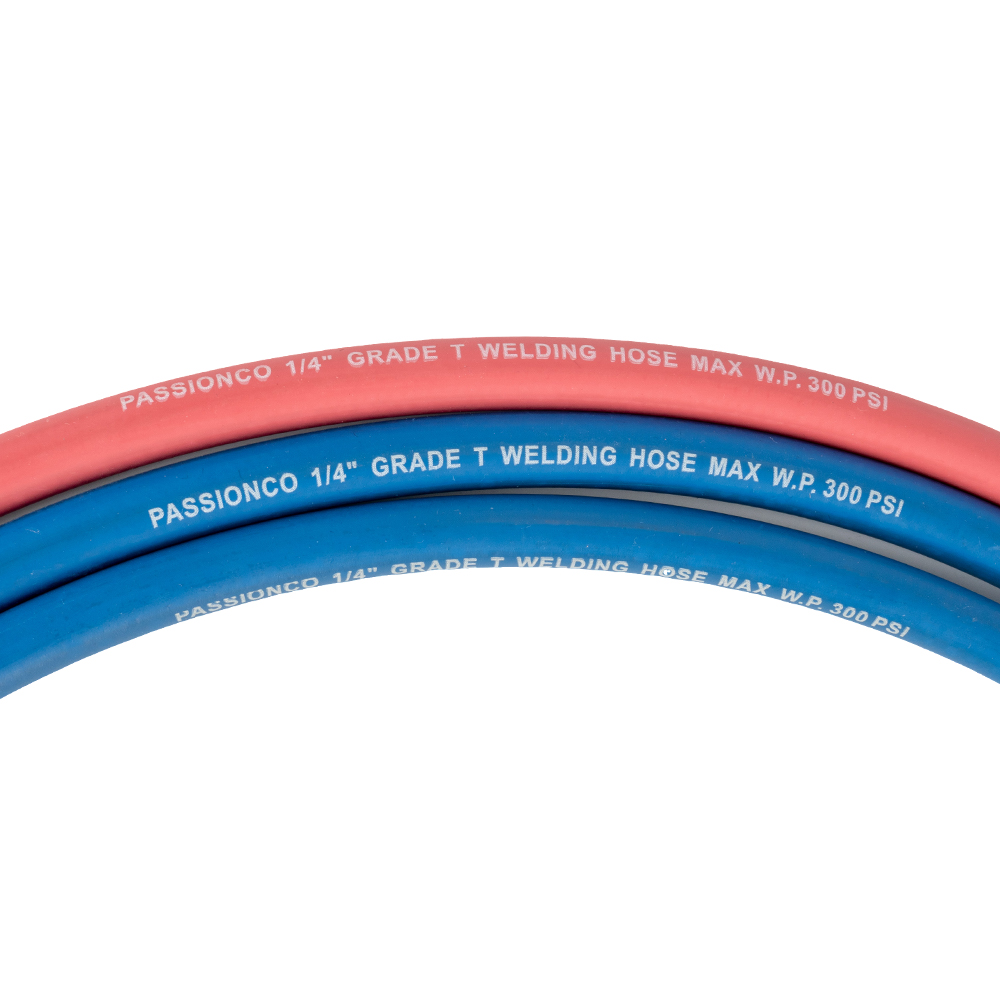
Choosing the Right Welding Hose: Key Considerations
There is no right or wrong when it comes to welding hose; the only thing that matters is your environmental conditions and the type of industry you are working in. While selecting the welding hose, special consideration should be given to its material. If you are looking for a construction or automotive industry, you must choose a rubber hose that is appropriate because of its flexibility. For energy or shipbuilding industries, welding hose with synthetic blends should be given weightage, given its resistance to UV and chemicals. While heavy-duty applications may demand reinforced braiding.
For the automotive industry, welding hoses with smaller diameters should be used. Likewise, welding hoses in the construction industry demand larger diameters for smooth and secure delivery of high-volume gases. Welding hose manufacturers make different welding hoses for different industries.

Passion Hose founded in 2007, a professional silicone hose manufacturer, a brand of pipeline hose and accessories R&D, production and sales. Main products: stainless steel shower hose,hydraulic hose, industrial hose, automotivehose, plumbing hose etc., which are widely used in home, hotel, industry and other fields.
Quick Links
Products
If you have any question, please contact us.
Email: ps1@passioncohose.com
Tel: +86-136-6663-2043
Whatsapp: +86-13666632043
Add: B-101, Hangzhou Smart Industrial Park, No. 857, Wenyixi Rd. Hangzhou, 310030, China